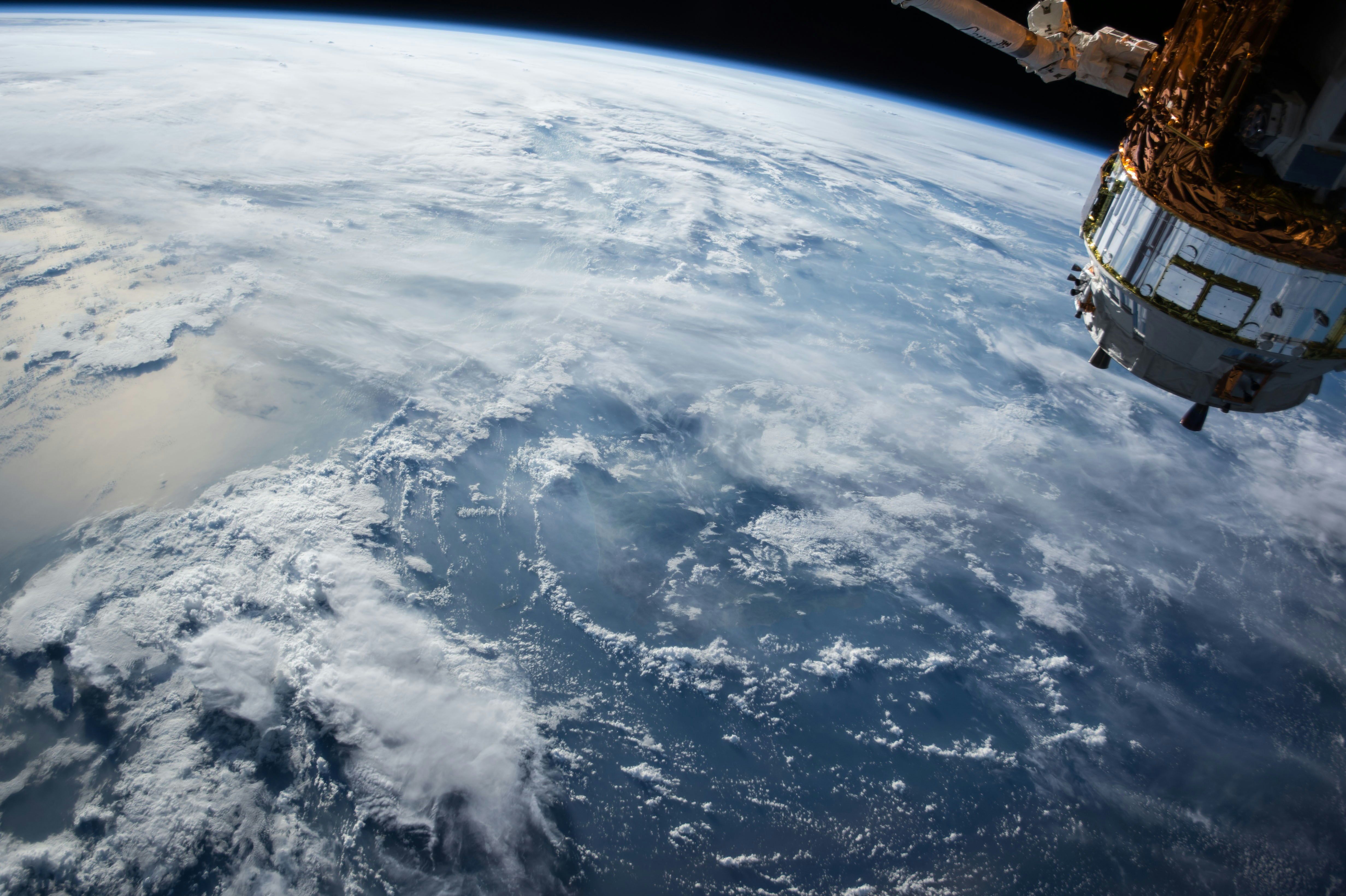
A Planet Surrounded by Trash
The next environmental disaster may not begin on Earth.
Orbiting above us are more than 100 million pieces of space debris: broken satellites, used rocket parts, and shards of metal left from decades of launches.
They move at speeds up to 17,000 miles per hour. Each one, even as small as a screw, can destroy a spacecraft on impact.
But the danger isn’t just to astronauts or billion-dollar satellites. Space debris is quietly reshaping how we study, understand, and respond to climate change itself.
Why Space Junk Matters for the Planet
Earth’s orbit is getting crowded. Every launch adds more fragments, and collisions create clouds of debris that can stay in orbit for centuries.
This clutter threatens the satellites we depend on to monitor weather, track sea-level rise, and measure carbon emissions.
Without these satellites, we would lose one of the most important tools in the fight against climate change: data.
If space becomes too dangerous to navigate, scientists could struggle to predict hurricanes, monitor droughts, or verify carbon-reduction pledges.
The race to clean up Earth’s orbit is, in many ways, a race to protect the planet below.
How We Got Here
The space race of the 20th century left a legacy beyond exploration: a ring of junk around Earth.
More than 8,000 active satellites orbit the planet today, but over 30,000 trackable fragments are dead or drifting. The rest are too small to detect, yet large enough to cause damage.
As private companies launch mega-constellations of thousands of satellites, the risk of collision rises exponentially. One crash can trigger a chain reaction called the Kessler Syndrome, a cascade of debris that could make low-Earth orbit unusable for decades.
The Environmental Cost of Reaching Space
Every rocket launch releases soot and alumina particles into the upper atmosphere, where they trap heat and damage the ozone layer.
While spaceflight emissions are small compared to aviation, they are concentrated at high altitudes, where their warming impact lasts longer.
If launch rates continue to rise, rocket pollution could become a real contributor to climate change.
In a cruel twist, the satellites meant to help us understand the climate crisis might be worsening it.
What’s at Stake
Losing reliable satellites wouldn’t just affect scientists. It would touch every aspect of modern life:
- GPS and navigation systems
- Global internet connections
- Agricultural monitoring
- Disaster early-warning systems
Space debris is not a distant issue. It’s an invisible infrastructure crisis, orbiting above our heads.
The Bigger Picture
Environmentalism often looks at oceans, forests, and cities. But the next frontier of sustainability might require looking up.
The story of space junk mirrors the story of climate change: rapid innovation without long-term responsibility.
Both challenge us to rethink how we use shared environments, whether it’s the atmosphere above our cities or the one above our planet.
The Bottom Line
The climate crisis doesn’t stop at the edge of space.
If we want to protect Earth’s future, we also have to protect its orbit.
Cleaning up space won’t solve climate change, but without it, solving climate change becomes much harder.
Before we can heal the planet, we need to clear the sky.